 Posted by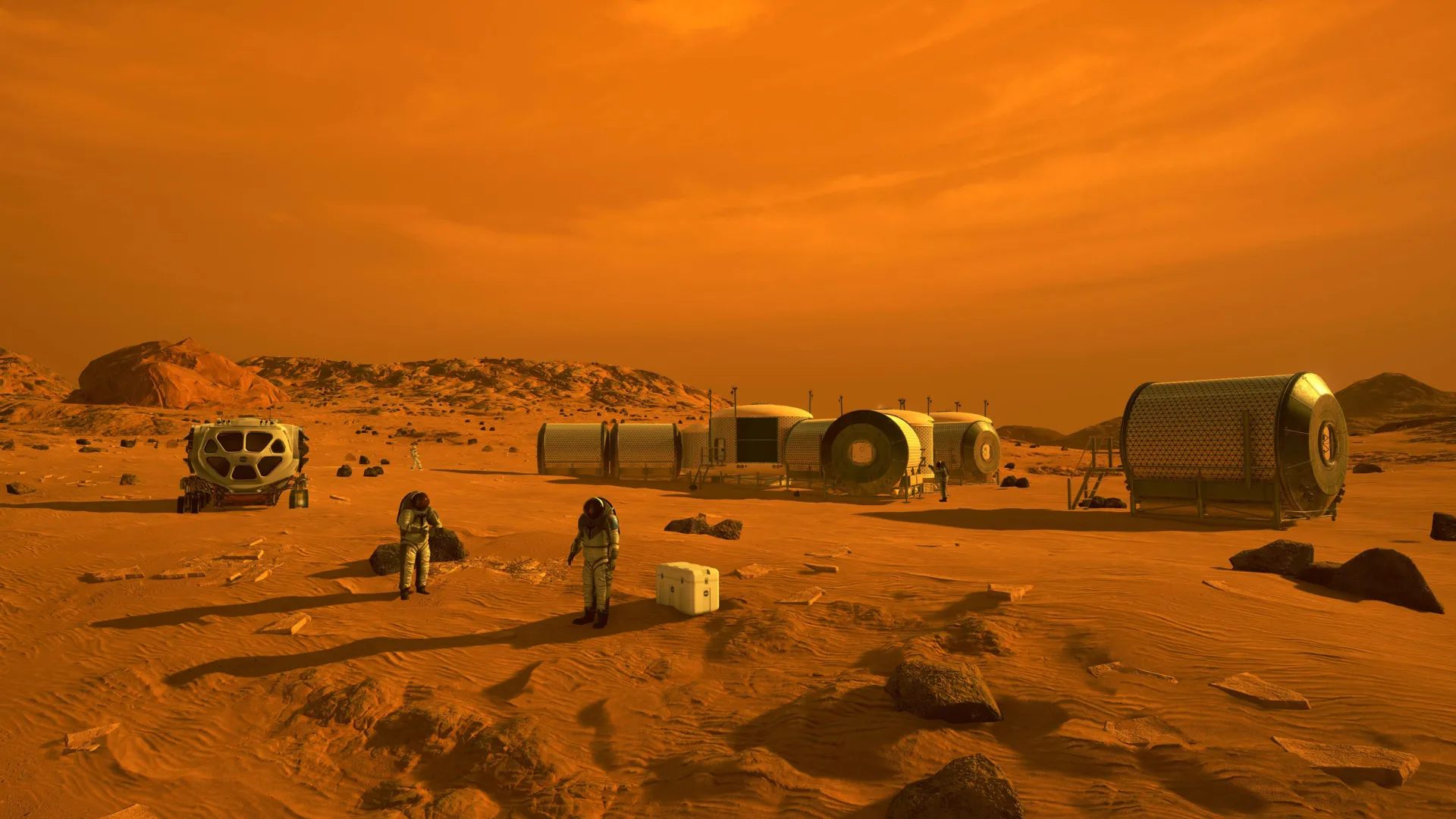

I recently rewatched Armageddon, complete with Bruce Willis, oil drillers sent into space, and an asteroid the size of Texas racing toward Earth. Beneath all the Hollywood spectacle is a fascinating question: What could humanity actually do with an asteroid if we were able to reach and use one?

The most valuable answer may have nothing to do with destroying it. Sorry, Bruce. Asteroids could instead help us build an entirely new world.
The Supply Problem Facing Mars
Establishing a colony on Mars would involve far more than solving difficult engineering challenges. It would also require a reliable system for moving supplies, equipment, and raw materials across the Solar System.
Logistics may not sound especially exciting, but it could determine whether humans ever become a multiplanetary species or remain permanently tied to Earth.
A settlement on Mars would need more than food, water, and oxygen. It would require enormous amounts of metal, including structural steel for habitats, aluminum for machinery, and iron for tools. Equipment would also wear down, break, and eventually need to be replaced.
Regularly shipping all of those materials from Earth would not be a practical long-term solution. Launching a tonne of cargo can cost tens of millions of pounds, while a trip to Mars usually takes between six and nine months, depending on the positions of Earth and Mars in their orbits. That is far too slow and expensive for a dependable hardware supply system.
Mining Asteroids for Martian Metals
Researchers at EPFL in Switzerland have now calculated how asteroid mining could supply metals directly to Mars.
Millions of asteroids travel through the Solar System. Some of them, called M type asteroids, contain large quantities of iron, nickel, and other useful metals. In simple terms, they are enormous mineral deposits moving through space.
The central question is whether spacecraft could reach these asteroids, extract useful materials, and transport them to Mars without consuming so much energy and fuel that the entire effort becomes impractical.
The study’s answer is cautiously optimistic, although success would depend on several important conditions.
Finding the Best Space Supply Routes
The researchers used a computer program to test thousands of possible combinations across several potential supply chains. Their calculations included the energy needed to travel between Mars and different asteroids, the amount of metal that could realistically be collected, and the fuel required to complete the journey.
Return fuel is especially important, and this is where the plan becomes more inventive.
Some asteroids are carbonaceous, meaning they contain carbon and water ice. With the right processing methods, those materials could be converted into rocket propellant in space. Spacecraft would then avoid carrying all of their return fuel from Earth.
The researchers included this possibility directly in their supply chain models.
The Right Asteroids Could Make It Work
The results point to specific asteroids that could be reached using existing spacecraft technology. For these targets, the energy required for the full journey may be low enough to make mining and delivery worthwhile.
However, choosing the correct asteroid would be critical. A poorly selected target might require so much fuel that the value of the metals brought back would not justify the mission.
The study does not mean asteroid mining is about to begin. Humanity is still a long way from operating its first mine in space.
Its importance lies in showing that the logistics problem can be solved. A future supply network could move metals from asteroids to Mars while using propellant produced from asteroid resources.
A Mars colony would need people to build it. Just as importantly, it would need a dependable system for delivering the materials those builders require. This research suggests such a system is possible.